

Choosing the correct CPT code in ABA involves more than knowing which number corresponds to which service. Coding decisions affect authorizations, reimbursement, and how easily a claim moves through payer review. In 2026, payers are examining documentation, unit limits, and time-based services more closely, which makes clear alignment between the service delivered and the code reported increasingly important.
This guide walks through the core ABA CPT codes used in 2026, explains what each represents, and outlines the billing considerations providers are navigating this year.
Why CPT Codes Matter in ABA Billing
Every ABA claim is built on two core elements: the diagnosis and the service delivered. The diagnosis (ICD-10) establishes medical necessity under a covered condition (why an autistic patient needs support). CPT codes show what actually happened during the appointment. When those two pieces do not match cleanly, payers usually deny the claim.
In ABA, CPT codes serve three important purposes:
- They help payers understand what type of service was delivered and at what level.
- They guide reimbursement by reflecting time, intensity, and provider roles.
- They anchor your documentation, ensuring session notes support medical necessity and authorization.
In 2026, payers are applying closer scrutiny to coding accuracy and documentation alignment. They want accurate codes, clear notes, and a clean match between the service billed and the work done. If the documentation does not clearly support the code reported, claims are more likely to be reduced, denied, or flagged for review. This is why a strong grasp of ABA’s CPT codes (and stringent coding practices within an organization) is crucial for safeguarding your revenue cycle.
The Core ABA CPT Codes Used in 2026
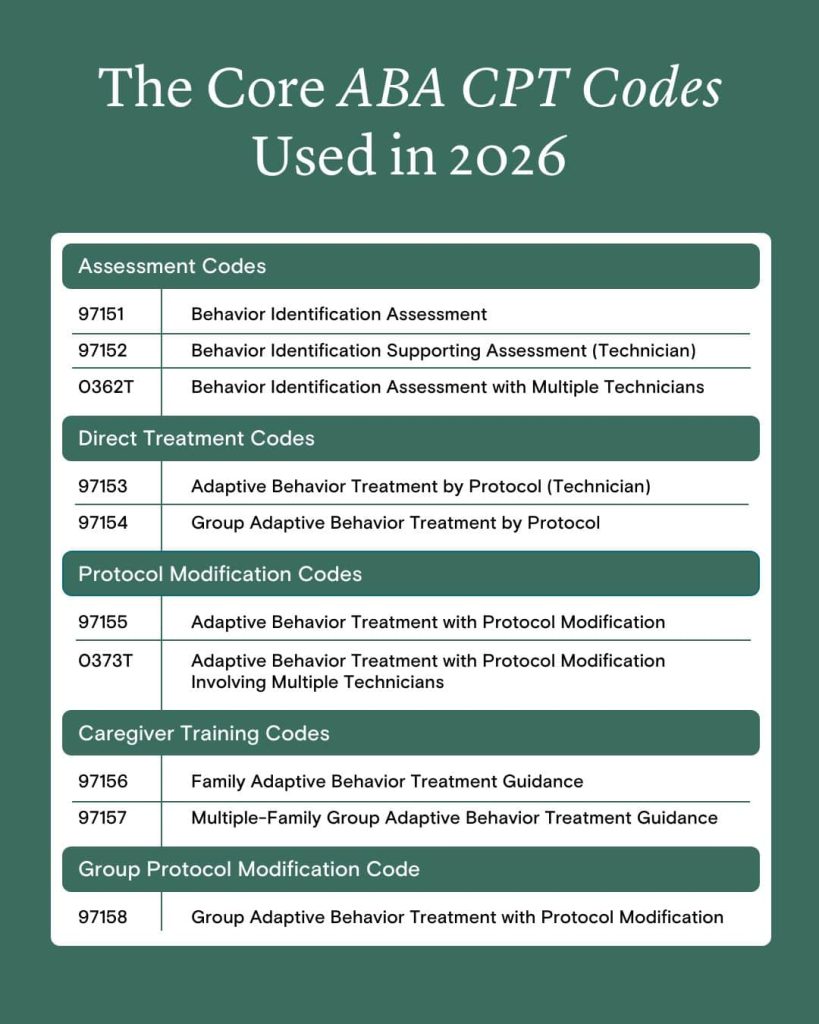
ABA uses a compact set of codes that describe assessment, treatment, protocol changes, caregiver training, and group services. Each code has a different purpose, and choosing the right one helps ensure claims move smoothly.
Below is a simple breakdown of what each category covers.
1. Assessment Codes
The following CPT code descriptors reflect official definitions used for adaptive behavior services.
97151 – Behavior Identification Assessment
“Behavior identification assessment, administered by a physician or other qualified health care professional, each 15 minutes of the physician’s or other qualified health care professional’s time face-to-face with patient and/or guardian(s)/caregiver(s) administering assessments and discussing findings and recommendations, and non-face-to-face analyzing past data, scoring/interpreting the assessment, and preparing the report/treatment plan.”
This is the primary assessment code. It covers the full evaluation process, including reviewing history, observing the patient, speaking with caregivers, analyzing data, and preparing or updating the treatment plan.
97152 – Behavior Identification Supporting Assessment (Technician)
“Behavior identification supporting assessment, administered by one technician under the direction of a physician or other qualified health care professional, face-to-face with the patient, each 15 minutes.”
This code is used when a technician assists with structured assessment activities under a qualified health care professional’s supervision. Think of hands-on tasks like preference assessments, direct probes, or data collection for the evaluation.
0362T – Behavior Identification Assessment with Multiple Technicians
“Behavior identification supporting assessment, each 15 minutes of technicians’ time, face-to-face with a patient, requiring the following components:
- administered by the physician or other qualified health care professional who is on site,
- with the assistance of two or more technicians,
- for a patient who exhibits destructive behavior,
- completed in an environment that is customized to the patient’s behavior.”
This is reserved for complex cases where safety risks or severe behaviors require a qualified health care professional on site and multiple technicians working together.
2. Direct Treatment Codes
97153 – Adaptive Behavior Treatment by Protocol (Technician)
“Adaptive behavior treatment by protocol, administered by technician under the direction of a physician or other qualified health care professional, face-to-face with one patient, each 15 minutes.”
This is the most common treatment code. Use it when a technician delivers structured adaptive behavior treatment following the established protocol.
97154 – Group Adaptive Behavior Treatment by Protocol
“Group adaptive behavior treatment by protocol, administered by technician under the direction of a physician or other qualified health care professional, face-to-face with two or more patients, each 15 minutes.”
This applies when the technician works with two or more patients at the same time, delivering treatment based on a consistent protocol.
3. Protocol Modification Codes
97155 – Adaptive Behavior Treatment with Protocol Modification
“Adaptive behavior treatment with protocol modification administered by a physician or other qualified health care professional, which may include simultaneous direction of technician, face-to-face with one patient, each 15 minutes.”
Use this code when the qualified health care professional actively adjusts the program during the session.
0373T – Adaptive Behavior Treatment with Protocol Modification Involving Multiple Technicians
“Adaptive behavior treatment with protocol modification, each 15 minutes of technicians’ time face-to-face with a patient, requiring the following components:
- administered by the physician or other qualified health care professional who is on site,
- with the assistance of two or more technicians,
- for a patient who exhibits destructive behavior,
- completed in an environment that is customized to the patient’s behavior.”
4. Caregiver Training Codes
97156 – Family Adaptive Behavior Treatment Guidance
“Family adaptive behavior treatment guidance, administered by physician or other qualified health care professional (with or without the patient present), face-to-face with guardian(s)/caregiver(s), each 15 minutes.”
This code is designed for structured caregiver sessions focused on teaching strategies, coaching, modeling, and troubleshooting. The individual receiving the services may be present, but the emphasis is on improving caregiver confidence and consistency.
97157 – Multiple-Family Group Adaptive Behavior Treatment Guidance
“Multiple-family group adaptive behavior treatment guidance, administered by physician or other qualified health care professional (without the patient present), face-to-face with multiple sets of guardians/caregivers, each 15 minutes.”
Use this when you are running group education or guidance sessions for multiple families at once. To bill it correctly, the session should still be tied to treatment goals, not general education.
5. Group Protocol Modification Code
97158 – Group Adaptive Behavior Treatment with Protocol Modification
“Group adaptive behavior treatment with protocol modification, administered by physician or other qualified health care professional face-to-face with multiple patients, each 15 minutes.”
Use this when a qualified health care professional is actively making adjustments during a group treatment session.
How to Choose the Right ABA CPT Code
A simple way to code accurately is to follow a five-part decision path.
1. What was the purpose of the session?
Assessment? Treatment? Caregiver training? Group work?
Your answer immediately narrows the code set.
2. Who delivered the service?
Technician: 97152, 97153, 97154
Physician or qualified health care professional (QHP): 97151, 97155, 97156, 97157, 97158
3. Was the service individual or group?
Group services always use 97154 or 97158.
4. Was the treatment modified?
If the clinician made real-time changes during the session, it becomes a protocol modification service, not standard treatment.
5. Does the documentation match the code?
Your note must clearly reflect what the code requires – goals, progress, interventions, and the role of the person delivering care.
If any part of the service does not match the code criteria, it is safer to choose the simpler code that accurately reflects the session.
What’s New in 2026: Key Billing and Coding Changes
ABA codes themselves have not changed dramatically, but the way payers expect providers to use them has.
Weekly approved units
Some payers have now moved to weekly unit structures. Instead of authorizing a large bank of units over several months, they now assign a set number of units per week. Claims must reflect the units delivered within that specific week. Anything above the weekly cap may be reduced or denied.
This affects:
- Scheduling patterns
- Treatment planning
- How authorizations are requested
- How claims are submitted each week
Practices need to coordinate programming and billing teams to prevent surprise write-offs.
Telehealth variation
Telehealth rules continue to differ by payer. Some allow assessment, caregiver training, and protocol modification via video. Others limit technician services delivered remotely. Before scheduling telehealth, teams should confirm which ABA therapy CPT codes are covered and whether modifiers are needed.
Preparing for the 2027 changes
The adaptive behavior codes will undergo revisions in 2027. The exact language will appear late in 2026, making this year the ideal time to ensure clean workflows, solid documentation habits, and consistent coding before the new structure arrives.
Common Coding Errors and How to Avoid Them
- ICD and CPT mismatches: If the diagnosis does not support the intensity or type of service billed, claims are often denied for medical necessity.
- Overlapping time units: ABA codes are time-based. Make sure two billed services do not cover the same minutes unless payer rules specifically allow it.
- Wrong provider type: A technician cannot bill clinician-level codes, and clinicians should not default to technician codes when the service requires clinical decision-making.
- Documentation gaps: Notes must describe the service billed – including goals, methods, time spent, and caregiver involvement when applicable. Missing details create audit risks and denials.
Best Practices for Accurate Coding in 2026
To use CPT codes for ABA therapy accurately and reduce denials:
- Keep payer-specific rules and telehealth policies easily accessible for staff.
- Create coding templates in your EMR that match each service type.
- Align authorization requests with the exact services and weekly limits you expect to deliver.
- Recheck eligibility and Coordination of Benefits regularly.
- Document sessions promptly so details are not lost.
- Track denials by pattern to spot coding or documentation trends.
Good coding is not just administrative – it protects care continuity and ensures autistic clients receive consistent services without interruptions.
How Missing Piece supports accurate coding and clean claims
Accurate CPT codes for ABA therapy, strong documentation, and aligned authorizations work best when they sit within a well-organized revenue cycle. If your practice wants to improve coding accuracy, strengthen compliance, or streamline end-to-end billing workflows, Missing Piece offers resources that can help you move forward confidently.
To explore solutions that support cleaner claims and more predictable revenue, you can start here:
- Our full suite of ABA-focused solutions
- A deeper look at revenue cycle management for ABA practices
- A practical guide to the essentials of ABA billing
- How to choose the right medical billing partner for your practice
These resources support consistent use of ABA CPT codes, stronger documentation habits, and cleaner claims, giving your practice more time to focus on delivering meaningful, high-quality support to autistic individuals and their families.