

ABA provider networks are changing fast. As payers tighten requirements and shift toward outcome-driven care, practices face increased scrutiny, contract risk, and billing complexity. Understanding what’s driving these changes, and how to respond, is critical to protecting both revenue and continuity of care.
Why ABA Networks Are Tightening in 2026
ABA networks are tightening as payers move away from open expansion and toward tighter control over how services are delivered and reimbursed.
Over the past few years, demand for ABA services has increased rapidly, and many networks have expanded to keep up. While this has improved access, it has also made it harder to maintain consistent standards across providers operating at scale.
That shift is now being addressed.
Insurers and Medicaid programs are taking a more structured approach to network design. Rather than continuing to grow, they are reassessing provider participation and applying clearer expectations across the full cycle of care.
This change is being driven by a few key priorities:
- Greater control over rising utilization and long-term costs
- More consistent standards across providers within the same network
- Clearer alignment between authorized services and delivered care
- Increased accountability for how care is planned, delivered, and reviewed
Industry leaders are describing 2026 as a shift from growth to proof. Payers are increasingly demanding that providers demonstrate not just that they can deliver timely care, but that it is high-quality and cost-effective. Cookie-cutter approaches, and volume-driven models alone, are under pressure.
This shift brings value-based care into sharper focus. For ABA providers, this introduces a higher level of scrutiny around how care is structured and how well it holds up under review. While ABA remains predominantly a fee-for-service sector, the shift from fee-for-service to value-based care is becoming harder to ignore — payers are increasingly introducing outcome and cost-efficiency expectations into how they evaluate and contract with providers.
As a result, networks are becoming more selective. Participation is no longer just about meeting demand. It is increasingly shaped by a provider’s ability to operate consistently, align with payer expectations, and support care with clear, defensible processes.
What This Means for ABA Providers and Families
Network changes are already affecting how care is delivered, accessed, and sustained across ABA services.
Recent events have illustrated how quickly these changes can affect families on the ground. In late 2025 and into 2026, contract disputes between Medicaid insurers and some of the largest ABA providers in Arizona left hundreds of families scrambling to find new providers, in a state already facing significant provider shortages. Arizona is not an isolated case — similar disputes over reimbursement rates and network adequacy have surfaced in other states. For practice owners, it is a clear signal that payer relationships, which once felt stable, can shift with limited notice, triggering credentialing stalls, re-contracting delays, authorization lapses, and disruptions to continuity of care.
Impact on ABA Practices
For providers, tighter networks introduce a more uncertain operating environment.
Changes to payer contracts, authorization requirements, and review processes can happen quickly, often with limited transition time. Practices may need to renegotiate participation, adapt to new expectations, or exit networks altogether.
What this means for practices:
- Less predictability in payer relationships
- Greater exposure to contract and authorization changes
- Increased pressure on revenue stability
Even when demand remains strong, disruptions in authorizations or shifts in payer requirements can affect cash flow.
The pressure is not limited to contract terms. Payers are also scrutinizing utilization more closely, with cost containment now a stated priority across both commercial and Medicaid plans. Providers are no longer operating in a system where volume alone sustains revenue. Network tightening is also introducing direct financial risk for practices: reimbursement cuts, narrower provider panels, prepayment review, recoupment pressure, and tougher credentialing standards are all becoming more common realities. There is growing pressure to show that services are appropriate, necessary, and aligned with outcomes.
Administrative demands are also increasing. More frequent reviews and stricter controls mean that disconnects between clinical delivery, scheduling, and billing are more likely to surface.
Impact on Autistic Patients and Families
For autistic patients and their families, network restructuring can disrupt continuity of care.
When providers leave a network or lose contract status, families may need to transition to a new provider with little notice. This can interrupt established routines and delay progress.
This can lead to:
- Disruptions to consistent care and therapist relationships
- Fewer in-network provider options
- Delays linked to authorization changes or transitions
Even when providers remain in-network, tighter authorization controls can affect how services are delivered. Changes to approved hours or review timelines can alter treatment plans and reduce consistency.
These impacts are not separate from operational decisions. How networks are structured and managed directly affects the stability of care for the families relying on it.
Operational Pressure Points Practices Can’t Ignore
As payer requirements become more structured, internal operations are being examined more closely.
Processes that once operated with some flexibility are now expected to hold up under consistent review. Disconnects between clinical delivery, scheduling, and billing are more likely to surface, particularly when expectations are applied across the full cycle of care.
Scheduling and Authorization Alignment
Scheduling now plays a direct role in whether services are delivered as approved and reimbursed without issue.
Misalignment between authorized hours and actual delivery can create downstream challenges, even when clinical intent is appropriate. This is where scheduling workflows and systems become more critical.
Where issues tend to surface:
- Scheduled hours do not reflect current authorizations
- Updates to authorizations are not applied in real time
- Gaps between planned and delivered sessions are not clearly tracked
These inconsistencies can lead to denials, delays, or additional review. Over time, repeated misalignment may also affect how a provider is evaluated within a network.
Documentation and Billing Consistency
Documentation and billing are being reviewed more closely against payer expectations.
Clear, consistent records are essential for supporting claims, particularly as ABA billing guidelines continue to evolve. As of January 1, 2026, CMS finalized the permanent addition of ABA CPT codes to the telehealth list for Medicare and Medicaid. Practices offering remote services should note that medical necessity requirements still apply and documentation must reflect this clearly.
Practices should also be aware that a significant CPT code overhaul (announced by the ABA Coding Coalition) is set to take effect January 1, 2027, with new codes, revisions, and deletions to the existing set. Preparation for this transition should begin now.
When documentation does not fully support billed services, practices become more exposed to denials, recoupments, or extended review cycles. For a more comprehensive breakdown, our guide to ABA billing for therapy practices outlines where inconsistencies typically arise.
Where issues tend to surface:
- Session notes do not fully support billed services
- Clinical records and submitted claims do not align
- Documentation standards vary across providers or teams
In many cases, these issues are not isolated errors. They reflect gaps between teams or processes that have not adapted to changing requirements.
Revenue Cycle Performance and Visibility
Revenue cycle performance is becoming less tolerant of gaps and delays.
Breakdowns in authorizations, claim submission, or follow-up processes can quickly affect cash flow. Without clear visibility across the revenue cycle, it becomes harder to identify where issues originate or how they compound over time.
Where issues tend to surface:
- Delays tied to authorization or reauthorization workflows
- Claim denials linked to incomplete or misaligned information
- Limited visibility into where revenue leakage is occurring
As reimbursement models evolve, this pressure increases. The shift toward greater payer scrutiny means practices must manage claims efficiently while also ensuring that services are supported, measurable, and aligned with payer expectations.
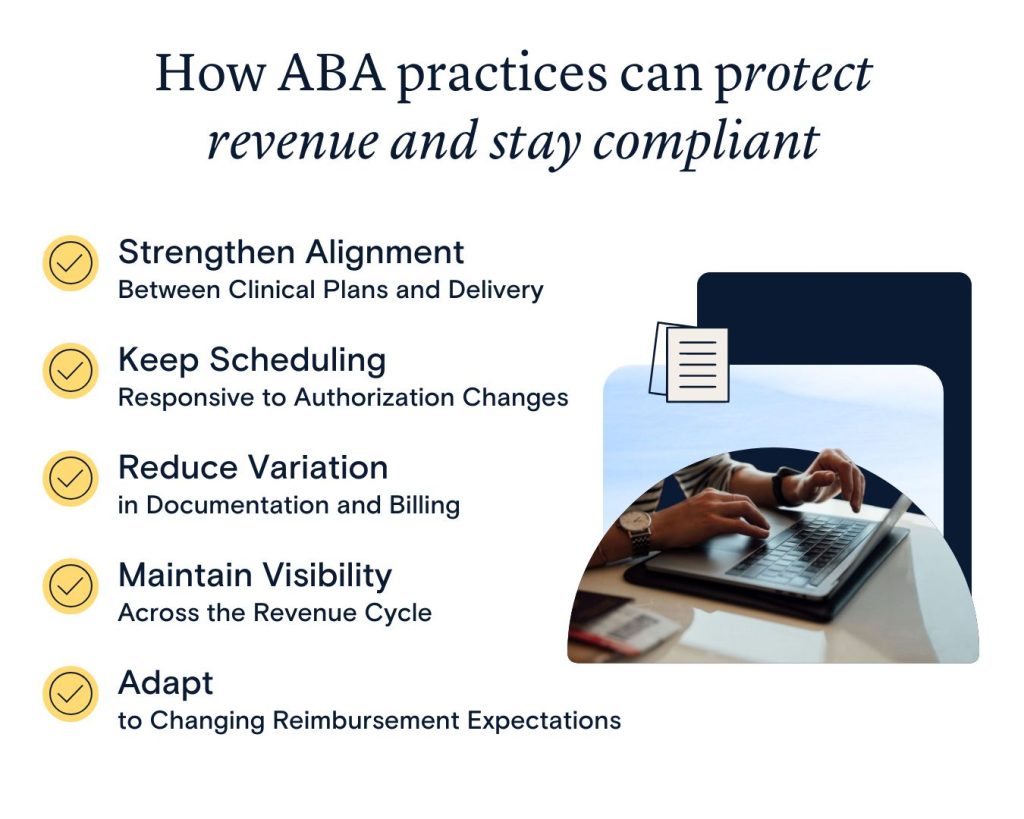
How ABA Practices Can Protect Revenue and Stay Compliant
As payer expectations become more defined, protecting revenue depends on how well internal processes hold up under review.
This is less about adding new systems and more about tightening the points where misalignment tends to occur.
Strengthen Alignment Between Clinical Plans and Delivery
Authorized services, treatment plans, and delivered sessions need to remain tightly aligned.
When care delivery drifts from what has been approved or documented, even minor gaps can create issues during review. This becomes more relevant as payers increase focus on measurable outcomes and appropriate utilization, where services must be clearly supported and justified.
Regularly reviewing how planned services compare to delivered hours helps surface inconsistencies before they affect reimbursement.
Keep Scheduling Responsive to Authorization Changes
Scheduling cannot operate independently from authorization.
As approvals change, ABA schedules need to reflect those updates without delay. Lag between authorization changes and scheduled services is one of the more common sources of avoidable denials.
Using effective scheduling systems means tracking authorized hours alongside delivered services and adjusting in real time, not after the fact.
Reduce Variation in Documentation and Billing
Variation across providers and teams is one of the first things that surfaces under review.
As ABA billing guidelines continue to evolve (and with significant coding changes on the horizon for 2027), documentation and billing workflows need to follow consistent standards. When records, claims, and supporting documentation do not align, practices become more exposed to denials and recoupments.
Reducing variation does not require overcomplication. It requires clarity in how services are documented and how that documentation supports what is billed.
Maintain Visibility Across the Revenue Cycle
Revenue cycle performance depends on how quickly issues can be identified and addressed.
Breakdowns in authorizations, claim submission, or follow-up processes rarely happen in isolation. Without visibility, they tend to compound.
Tracking where delays occur, whether in approvals, submissions, or denials, makes it easier to address root causes rather than reacting to outcomes. A structured approach to revenue cycle management for ABA therapy can help identify where these breakdowns occur and how to resolve them.
Adapt to Changing Reimbursement Expectations
Payers are under significant financial pressure, and that pressure is flowing directly to providers through rate negotiations, utilization reviews, and network decisions. Practices that maintain tighter operational control are better positioned to navigate these changes without disruption. For those evaluating external support, choosing the right ABA billing partner is a decision worth approaching carefully.
Looking Ahead: Navigating a More Structured ABA Landscape
ABA networks are becoming more defined, and that shift is unlikely to reverse.
For practice owners, the focus is no longer only on growth or demand. It is on maintaining alignment across clinical delivery, scheduling, and billing as payer expectations become more structured.
Practices that operate with consistency and clear internal control are better positioned to remain in-network and sustain stable revenue.
Missing Piece specializes in ABA billing services and revenue cycle management, supporting practices to stay compliant, reduce denials, and maintain visibility across their revenue cycle as payer expectations continue to evolve.
As payer expectations tighten, operational gaps become financial liabilities. Practices that align scheduling, authorization, and billing now will be better positioned to protect revenue and preserve payer access. Connect with our ABA billing specialists to discuss next steps.