

If your ABA clinic relies on Medicaid reimbursement, you’ve likely noticed oversight getting tighter. State agencies and managed care plans are expanding data monitoring, and claims are being reviewed more closely than they were just a few years ago.
In 2026, documentation accuracy, coding details, and authorization controls are under greater scrutiny. Even small inconsistencies between authorizations, session notes, EVV records, and submitted claims can lead to denials, payment delays, or requests for additional records.
The biggest shift for many providers isn’t new rules; it’s stricter enforcement. Medicaid systems now use automated claim edits, authorization cross-checks, and data comparisons to flag issues earlier in the payment process.
Because Medicaid is administered at the state level, the exact requirements still vary from state to state. But most providers are navigating a similar set of core billing expectations that directly affect claim approval and payment timelines.
Across many Medicaid programs, ABA providers commonly need to manage:
- Prior authorization requirements for the majority of ABA services
- Electronic visit verification (EVV) for many home and community-based services
- Required use of nationally recognized CPT-based Medicaid ABA billing codes
- State-specific telehealth coverage and modifier rules
- Expanded program integrity reviews and audit activity
These requirements aren’t new. What’s changed is how closely they’re monitored. Even minor inconsistencies in documentation are more likely to trigger payment disruption, reinforcing the importance of understanding how ABA clinics can navigate revenue risks in a tighter reimbursement environment.
Prior Authorization Drives Payment Approval
Prior authorization plays a major role in whether ABA services are reimbursed under Medicaid. Before treatment can begin, most Medicaid programs and managed care plans require documentation showing that services are medically necessary.
In practice, that means authorization requests typically include:
- A current diagnostic evaluation
- A treatment plan tied to measurable goals
- The number of service units requested and the expected service frequency
- Clear authorization start and end date
Where many ABA providers run into trouble is when those authorization details don’t line up with what was actually delivered. If services fall outside the approved date range or exceed authorized units, the claim may be denied, even when the therapy itself was clinically appropriate.
Because of this, strong authorization management is an important part of day-to-day operations for many clinics.
Many organizations reduce payment risk by:
- Reviewing authorization expiration dates regularly
- Submitting renewal requests well before current approvals expire
- Comparing scheduled therapy hours against remaining authorized units
When authorization tracking is handled proactively, providers are far less likely to experience preventable claim denials or payment delays.
EVV Requirements May Apply to Some ABA Services
Electronic visit verification (EVV) was introduced under the 21st Century Cures Act for personal care and home health services. While ABA therapy is not universally included in those categories, some Medicaid programs require EVV for services delivered in home or community settings, particularly when they are funded through certain home and community-based services (HCBS) waivers.
When EVV is required, the system is designed to confirm that services billed to Medicaid were actually delivered as authorized.
Most EVV platforms capture basic visit details such as:
- Date of service
- Start and end time
- Service location
- Rendering staff member
For providers operating in states where EVV applies to ABA-related services, these records can directly affect claim processing. If EVV data does not align with submitted claims, managed care plans may:
- Pend claims for review
- Request additional documentation
- Deny payment
Because EVV requirements vary by state and program, ABA providers delivering in-home services should confirm whether EVV applies to their services and ensure visit data flows accurately into their billing system.
CPT Alignment Remains the Coding Standard
Most Medicaid programs rely on CPT-based codes to report adaptive behavior services. These codes form the foundation of ABA claims across both Medicaid and commercial payers.
What providers are seeing in practice is tighter editing around:
- Modifier accuracy
- Rendering provider requirements
- Unit limits tied to authorizations
- Invalid code combinations
Modifiers are especially important because many Medicaid programs require them to identify how services were delivered, who rendered them, or the setting in which care occurred.
Because coding guidance can change, billing teams should treat CPT maintenance as an ongoing responsibility. Annual CPT updates, state Medicaid bulletins, and managed care plan policies can all affect how ABA services must be reported.
Clinics that review their coding practices regularly, including periodic internal audits, tend to see fewer preventable denials and claim rejections.
Telehealth Rules Still Vary by State
Telehealth remains a useful service delivery option for some ABA providers, but there is no single national Medicaid policy governing how these services are billed. Each state Medicaid program sets its own rules for when and how telehealth may be used.
Depending on the state and managed care plan, policies may determine:
- Which ABA services may be delivered virtually
- Required modifiers or place-of-service codes
- Documentation requirements for telehealth visits
- Whether telehealth services are reimbursed at the same rate as in-person care
Because these rules vary widely, billing teams can run into compliance issues if they assume telehealth policies are consistent across states or payers.
Before submitting telehealth claims, providers should confirm:
- Current state Medicaid telehealth policy
- Specific requirements from the managed care plan
- Documentation expectations for virtual service delivery
Verifying telehealth requirements at both the state and plan level helps reduce avoidable claim rejections and billing errors.
Program Integrity Reviews Are Increasing
Medicaid agencies are expanding program integrity efforts, using data analytics and prepayment review tools to identify potential billing issues earlier in the claim process. Because ABA services are time-based and tied closely to authorizations, they are often subject to closer review.
During audits or claim reviews, Medicaid programs commonly look at areas such as:
- Documentation supporting medical necessity
- Accuracy of session duration and billed time
- Provider enrollment and rendering provider details
- Alignment between EVV records and submitted claims
- Unusually high utilization patterns
For ABA providers, this means clinical documentation, scheduling records, and submitted claims must stay closely aligned. When there are gaps between what was authorized, documented, and billed, those discrepancies are far more likely to be flagged during reviews than they were in previous years.
Operational Impact on ABA Providers
These Medicaid oversight standards extend beyond the billing department. Authorization controls, EVV reconciliation, and coding edits directly affect scheduling practices, documentation timelines, staffing coordination, and overall revenue predictability.
As enforcement becomes more data-driven in 2026, operational strain typically appears in several areas:
- Increased administrative workload tied to authorization tracking and renewal management
- Greater dependence on real-time documentation completion to prevent claim delays
- More frequent claim edits at submission due to tighter payer system controls
- Expanded requests for records and prepayment reviews from Medicaid plans
When clinical documentation, scheduling systems, and billing workflows are not tightly aligned, even small gaps can quickly compound into cash flow disruption. Strong revenue cycle management for ABA therapy providers helps organizations maintain better authorization oversight, submit cleaner claims, and reduce denial risk in an increasingly monitored Medicaid environment.
Practical Steps to Strengthen Medicaid Readiness
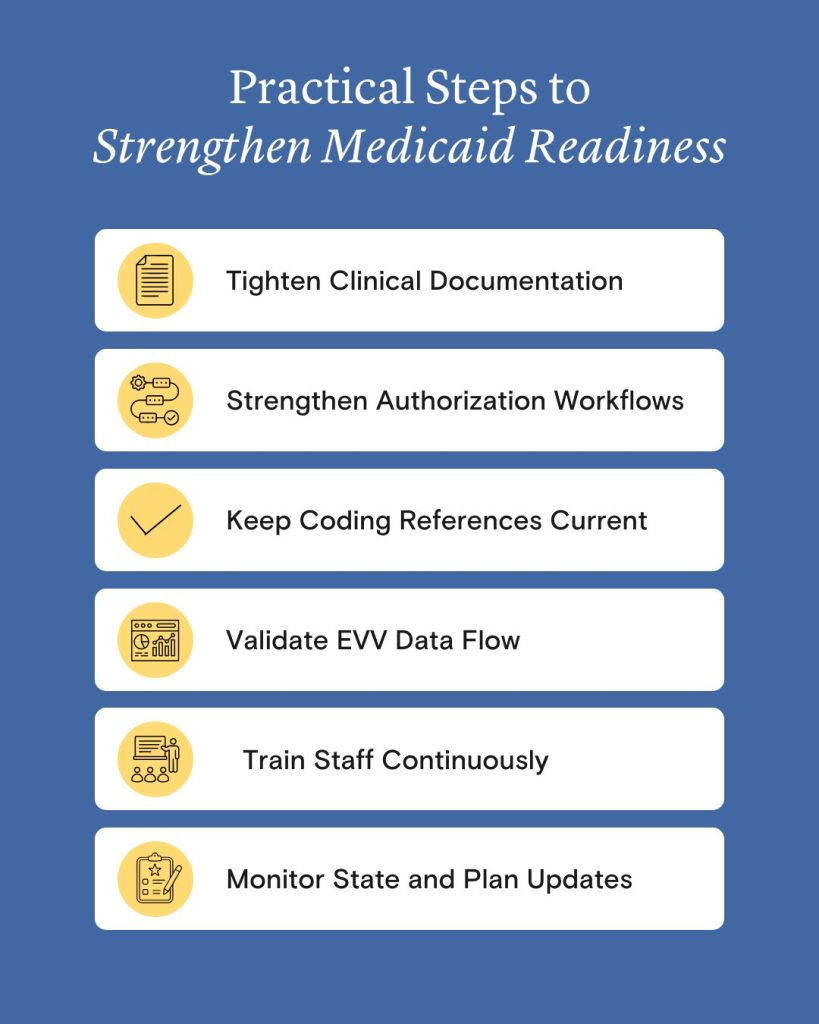
ABA providers can take several practical steps to reduce payment risk and stay compliant with current Medicaid requirements.
Tighten Clinical Documentation
Session notes should clearly support medical necessity, treatment goals, and the time billed for each service. Periodic internal reviews can help confirm that documentation aligns with what is ultimately submitted on claims.
Strengthen Authorization Workflows
Authorization tracking should be handled proactively. Many Medicaid denials occur when services are delivered outside the approved date range or exceed authorized units.
Clinics can reduce this risk by tracking authorization end dates, submitting renewals early, and regularly comparing scheduled therapy hours against remaining authorized units.
Keep Coding References Current
Coding requirements can change through annual CPT updates, state Medicaid bulletins, or managed care plan guidance. Billing teams should review coding references regularly to ensure modifier usage, rendering provider rules, and code combinations remain accurate.
Updating outdated billing logic in practice management systems can help prevent avoidable claim rejections.
Validate EVV Data Flow
Where EVV applies, providers should confirm that visit data flows accurately into the billing system and matches submitted claim details. Even small discrepancies in time, location, or rendering provider information can delay processing or interrupt payment.
Train Staff Continuously
Ongoing training for both clinical and billing teams helps reinforce documentation standards, authorization controls, and coding accuracy. Consistent education reduces preventable errors and keeps service delivery aligned with billing requirements.
Monitor State and Plan Updates
Because Medicaid policies are administered at the state level, requirements can change frequently. Reviewing Medicaid bulletins, provider notices, and managed care plan communications helps clinics stay ahead of modifier updates, coverage changes, and evolving documentation expectations.
A clear understanding of the differences between claims rejections vs. denials in ABA billing can also help providers prevent payment disruptions and resolve issues more quickly when they occur.
Navigating 2026 Medicaid ABA Billing with Operational Support from Missing Piece
The expectations surrounding Medicaid ABA billing are not fundamentally new in 2026, but the precision of enforcement continues to increase. As enforcement becomes more data-driven, providers need strong coordination across clinical teams, scheduling operations, and billing workflows.
With the right systems and oversight, providers can maintain compliance while protecting reimbursement in an increasingly monitored Medicaid environment. Missing Piece works with ABA providers to strengthen the operational systems that support accurate billing, authorization management, and revenue cycle performance.
Learn more about our available solutions, or speak with an ABA billing specialist about your workflows. Additional insights on revenue protection and compliance strategy are available within the Missing Piece resource library for providers refining their Medicaid workflows.