

As ABA clinics scale, billing demands increase alongside patient volume, payer requirements, and documentation expectations. Processes that were once easily manageable in-house can begin to strain internal processes, particularly as claim volume, follow-ups, and compliance requirements grow. This can affect reimbursement timelines and operational efficiency.
This article outlines key signals indicating when outsourcing your ABA revenue cycle management may be necessary.
Why Billing Becomes a Challenge for ABA Clinics
Billing complexity in ABA increases as clinics grow. Claim volume, authorizations, and payer interactions expand, often without a corresponding increase in internal billing capacity.
Working across multiple payers adds complexity. Each payer has different requirements for authorizations, documentation, and claims submission, making it harder to maintain consistency as patient volume increases.
This starts to affect how efficiently ABA revenue cycle management is handled, leading to:
- delays in claim submission
- gaps in documentation
- inconsistent follow-ups
These issues slow reimbursement cycles and increase the workload on internal teams. Over time, billing processes begin to fall out of sync with operational growth.
Key Signs It’s Time to Outsource ABA Billing
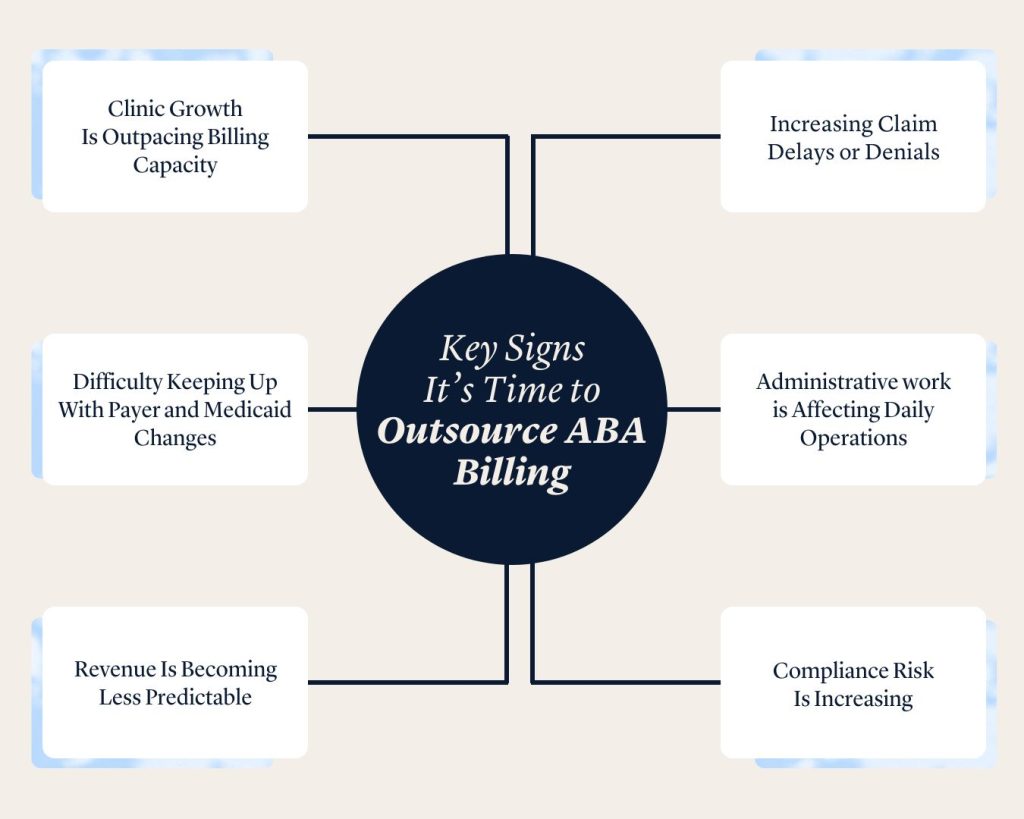
Often, the need for outsourcing is not due to a single issue. It evolves over time as billing demands increase and internal processes are stretched across operations, revenue management, and compliance.
Increasing Claim Delays or Denials
A rise in delayed or denied claims is usually one of the first indicators that billing processes are under pressure. As payer requirements become more specific, even small gaps in documentation or submission accuracy can interrupt reimbursement timelines.
When internal teams spend more time correcting claims than submitting them, it points to a breakdown in consistency. In these situations, clinics often turn to ABA insurance billing services to improve claim accuracy and reduce avoidable delays.
Administrative Work Is Affecting Daily Operations
Billing is closely tied to scheduling, authorizations, and communication with families and payers. When administrative work begins to interfere with these functions, it creates friction across the clinic.
This is common in teams where billing responsibilities are distributed across clinical and administrative roles. As workload increases, follow-ups are delayed, and processes become inconsistent. At this stage, ABA billing outsourcing becomes a way to separate clinical work from billing demands.
Difficulty Keeping Up With Payer and Medicaid Changes
Payer policies and Medicaid requirements change regularly. Updates to authorization rules, documentation standards, and billing guidelines affect how claims are processed and reimbursed. Differences between behavioral health and medical billing add complexity, with varying requirements for documentation, coding, and review across payers.
Without a structured approach, clinics are more likely to experience rejected claims or delays. Clinics that cannot keep pace often rely on outsourced ABA billing to maintain consistency across multiple payers.
Revenue Is Becoming Less Predictable
Unstable reimbursement is a clear signal that billing processes are not functioning as expected. Delayed payments, underpayments, and missed claims all affect cash flow, even when patient volume is consistent. Keeping up with ABA billing changes across payers, reimbursement structures, and authorization requirements adds another layer of pressure, making these disruptions more frequent when billing workflows are not kept up to date.
Variability across insurers adds another layer of complexity. Differences between:
- Primary and secondary coverage.
- Out-of-network benefits.
- Payer-specific billing and reimbursement rules.
These can affect how and when claims are paid.
Gaps in eligibility verification and coordination of benefits are often where revenue breaks down. In ABA settings, this typically shows up as:
- Claims that were routed to the wrong payer.
- Services processed as out-of-network.
- Partial or reduced reimbursement due to incorrect payer sequencing and coordination of benefits across plans.
These issues rarely stem from a single error. They reflect gaps across the billing cycle, from verification through to follow-up.
Compliance Risk Is Increasing
Billing errors increase compliance exposure. Inaccurate coding, incomplete documentation, and inconsistent claim handling raise the likelihood of audits and repayment requests. As payer documentation standards and review processes become more stringent, maintaining consistency becomes more difficult.
This is more complex when working across multiple insurers, where each payer has different expectations around:
- Authorization requirements
- Medical necessity criteria
- Documentation standards
- Billing for out-of-network services
Misalignment across these areas increases the risk of denials, recoupments, and post-payment review.
As clinics grow, maintaining consistent billing practices becomes more challenging. Working with teams that specialize in ABA therapy billing and insurance services helps reduce risk and keep processes aligned with payer requirements.
Clinic Growth Is Outpacing Billing Capacity
As clinics expand, billing volume increases alongside patient numbers. More claims, authorizations, and follow-ups require more time and coordination.
When billing capacity does not scale at the same rate, internal teams fall behind. This leads to delays, missed claims, and added pressure on staff. In these cases, reliable ABA insurance billing outsourcing services support growth without compromising billing performance.
What ABA Billing Outsourcing Solves
Outsourcing addresses specific breakdowns across billing workflows that affect claim processing, reimbursement timelines, and compliance with payer requirements.
Improves Claim Accuracy and Reduces Denials
Claim outcomes depend on accurate CPT coding, complete session documentation, and alignment with payer-specific billing rules. Errors in any of these areas can result in denials or rework.
Working with teams experienced in ABA insurance billing services helps ensure claims are submitted with correct coding, required documentation, and payer-aligned formats, reducing preventable denials.
Stabilizes Revenue and Cash Flow
Delays in reimbursement are often tied to gaps in claim submission, follow-up, or verification. Missed timelines, unworked denials, and incomplete claims can all affect cash flow.
Structured billing workflows improve tracking of claim status, ensure follow-ups are completed, and reduce delays caused by incomplete submissions. This is where ABA billing services support more consistent reimbursement cycles.
Strengthens Coordination Across Payers
Patients may have coverage across multiple insurers, including Medicaid and commercial plans. Claims must follow the correct payer order and reflect accurate coordination of benefits.
Outsourced billing teams help ensure:
- Eligibility is verified before services are billed
- The correct primary and secondary payers are billed in sequence
- Coordination of benefits is applied correctly
This reduces errors such as claims being routed to the wrong payer or processed incorrectly.
Reduces Administrative Burden on Internal Teams
Billing tasks include claim submission, denial management, payer follow-ups, and documentation checks. As volume increases, these responsibilities can affect scheduling, communication, and day-to-day operations.
Separating billing functions allows internal teams to focus on clinical and operational work and prevent burnout, while ABA billing outsourcing maintains consistent billing activity.
Supports Compliance and Documentation Standards
Payers require specific documentation to support medical necessity, session delivery, and billing accuracy. Incomplete or inconsistent records can lead to denials or post-payment review.
Working with providers of ABA therapy billing services and ABA therapy billing and insurance services helps ensure claims are supported by the required documentation and meet payer review standards.
Get Support With ABA Revenue Cycle Management
Working with a specialized billing partner allows clinics to manage claims, payer coordination, and follow-up processes with greater consistency.
This includes:
- Claim submission aligned with payer-specific requirements
- Denial tracking and resolution
- Eligibility verification and correct payer sequencing
- Documentation checks to support billing accuracy and medical necessity
Missing Piece provides ABA revenue cycle management services by handling these functions as a dedicated, structured process. Our solutions ensure billing is managed consistently across payers, claim types, and documentation requirements.
Contact our team to discuss your billing requirements.